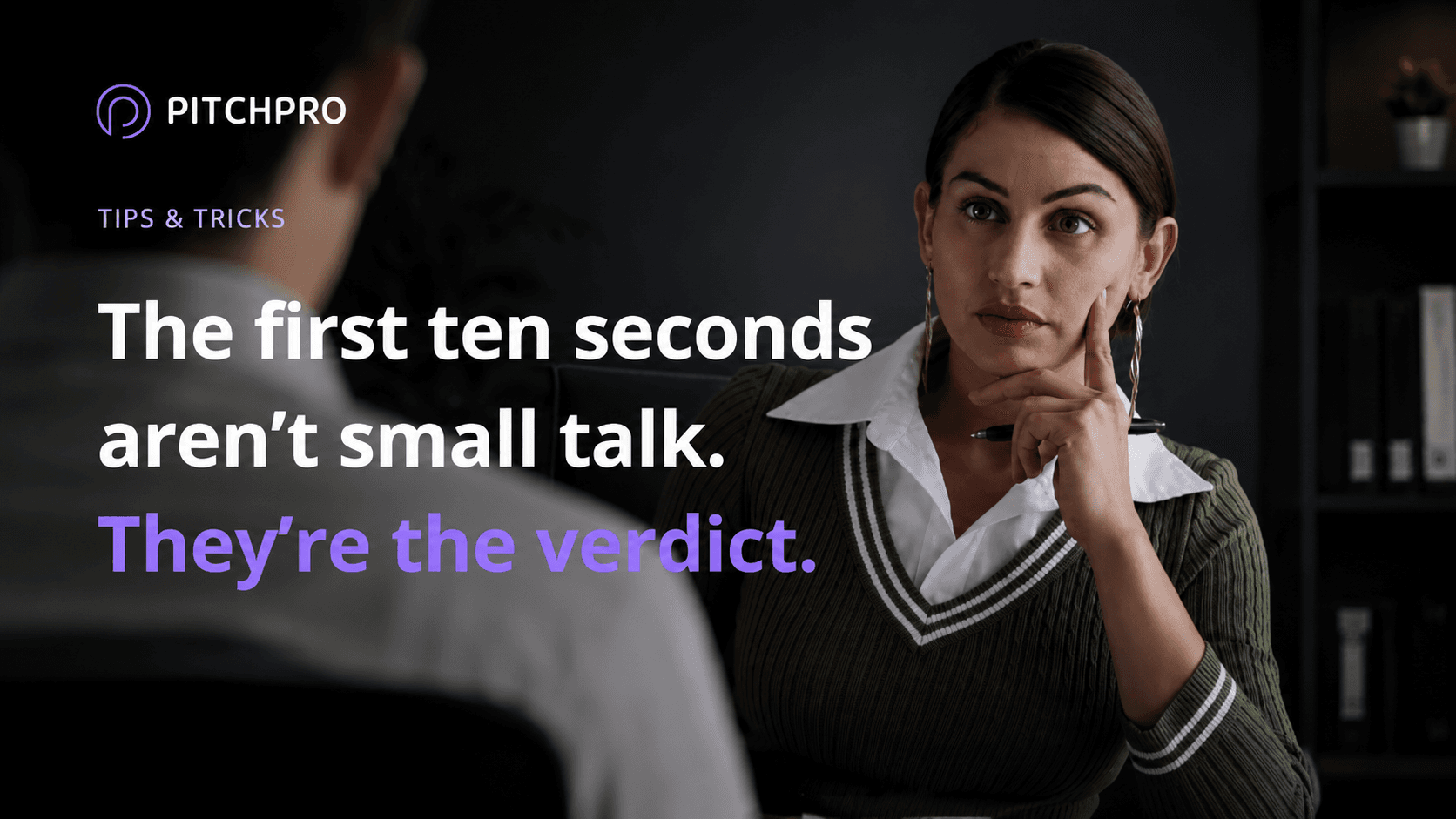
Interviewers do not wait for the good part. By the time an answer reaches the point, they may already have decided how they feel about the person giving it. The first ten seconds decide. Everything after that is just evidence, gathered to confirm a verdict that was already reached.
Most people do not plan their opening line. They just start talking and hope the sentence finds its own way home. That usually means trailing off, restarting, or burying a perfectly good answer under a pile of filler words nobody asked for.
Here is where that gap shows up in full view.
Weak Opener:
"Um, so, yeah, I guess my biggest strength would probably be like... communication? I think I'm pretty good at talking to people, usually."
Strong Opener:
"My biggest strength is communication. In my last role, I regularly translated technical details into plain language for clients who had no background in the subject."
Same person, same experience, same strength. One version sounds like someone doubting their own resume. The other sounds like someone who has said it out loud before.
Why the First Ten Seconds Carry So Much Weight
It's not that interviewers are unfair or impatient — it's that people process tone and confidence faster than they process content. A hesitant opener reads as uncertainty about the answer itself, even when the substance behind it is solid. By the time the strong details show up in sentence three, the interviewer may already be listening for reasons to confirm the first impression rather than update it.
That's what makes the opener disproportionately important. It's not the most informative part of the answer, but it's the part doing the most work.
What Happens When It Goes Wrong Mid-Sentence
Even a well-planned opener can stumble — a word gets lost, a thought jumps ahead of itself. When that happens, the instinct is usually to keep talking through it, hoping momentum will cover the gap. It doesn't. Powering through the panic just broadcasts it louder.
The better move is almost always the opposite: a pause and a clean restart. It feels exposed in the moment, but it reads as composure from the other side of the table. A short pause says "I know what I'm saying." A rushed recovery says the opposite, even when the words end up being the same.
This Is Where PitchPro's AI Feedback Earns Its Keep
Instead of guessing whether an opener actually lands, a candidate can practice the question out loud and hear back exactly where the pacing drags or the clarity slips — not a vague sense of "that felt off," but a specific breakdown of the moment it happened. It's a lot harder to fool yourself once it's broken down instead of just felt in the moment, and a lot easier to fix a ten-second opener than to fix an entire interview after the fact.
A Few Ways to Tighten the Opening
1. Lead with the answer, not the runway. Say the point, then explain it.
2. Cut the qualifiers. "Probably" and "I guess" undercut a perfectly good answer before it has a chance.
3. Practice the opener on its own. It deserves as much attention as the rest of the answer combined.
4. Listen back before assuming it sounded fine. It rarely sounds the way it felt.
Ten seconds is not a lot of time to make a case for yourself. It is, apparently, plenty of time to lose one.