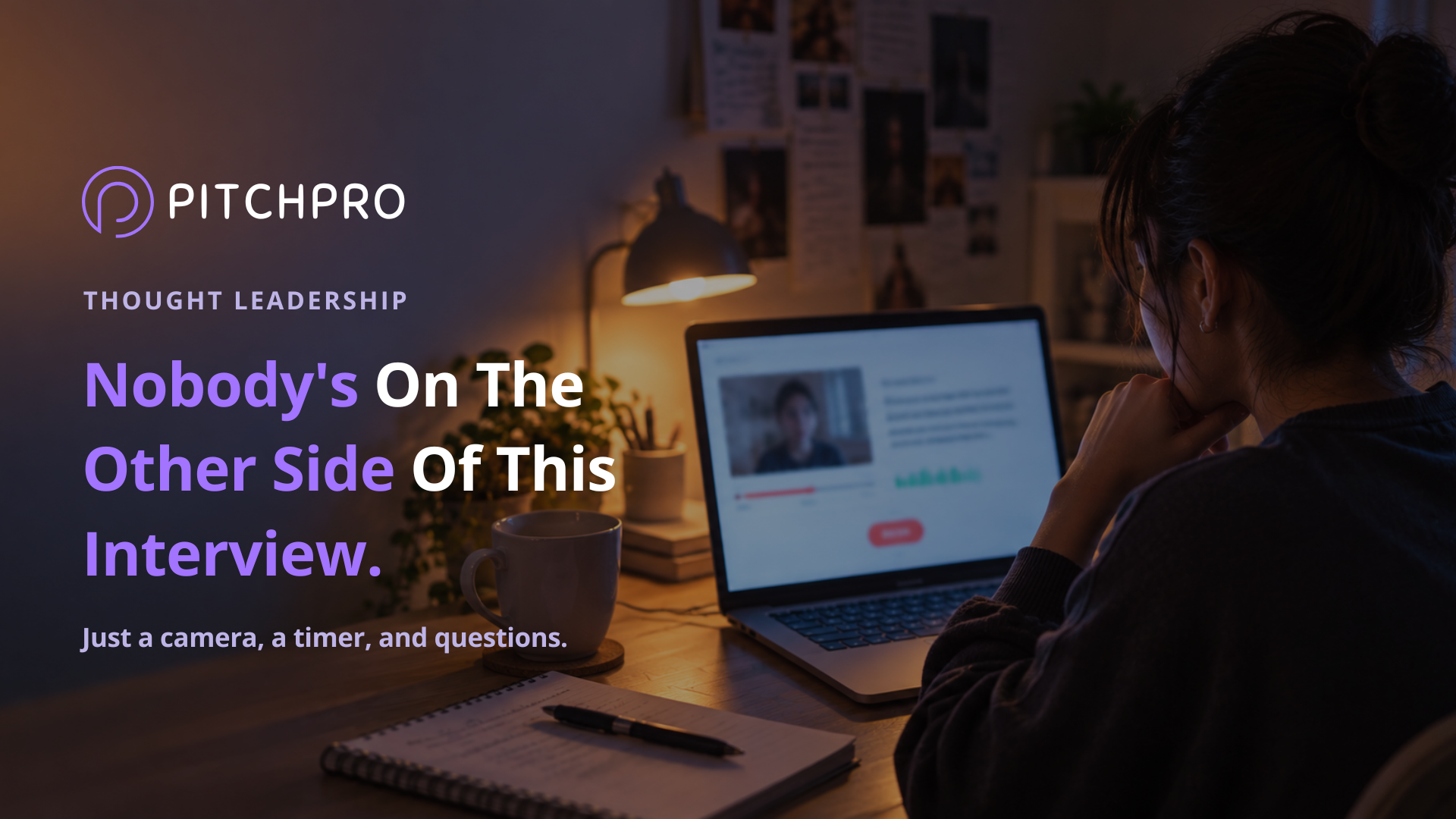
The question shows up on screen. You get a short window to read it, then the recording starts automatically. No button, no choice in the timing. A couple of minutes on the clock, one retake if the platform even allows it, and no live interviewer watching.
When you finish, or the timer runs out, it loads the next question by itself. Nobody nods. Nobody follows up. The only person who'll ever see this is a recruiter watching the recording back later. That's more or less exactly how platforms like HireVue run their own one-way interviews.
That's the interview now, for a growing share of graduate applicants, and it's arriving earlier in the process than almost anything else.
Qatar Is Already Building For This
It’s easy to assume this kind of automated screening is a distant, Western innovation that Qatar will adopt eventually. The data shows it's already underway here. PwC's 29th Global CEO Survey found that 84% of CEOs in Qatar report a clearly defined roadmap for AI initiatives, and the government-backed Ouqoul platform is expected to evolve into data-driven tools to streamline how graduates from Qatar's universities get hired, using the same data-driven screening tools now standard in high-volume recruitment elsewhere.
That's not a background trend. It's a stated part of how graduate hiring in the country is being rebuilt.
The pattern holds across the wider Gulf, too. A YouGov survey commissioned by HireRight found that just 7% of Saudi employers say their organisation isn't yet using AI somewhere in HR. Across the UAE, Saudi Arabia, and Qatar together, AI-related skills or tools appeared in 3.4% of professional vacancies in the first half of 2026, up from 1.2% in 2022, according to GulfTalent's analysis of over 118,000 postings.
Markets with a longer history of graduate hiring at scale show the same pressure, just later and sometimes more slowly. That same YouGov survey found 42% of UK employers still say they aren't using AI in HR at all, even as the Institute of Student Employers' 2025 Student Recruitment Survey recorded a record 140 applications per graduate vacancy, the highest since ISE records began in 1991, and one-way interviews specifically grew by 30% between 2020 and 2022.
Why the Room Went Quiet
Most interview advice still assumes someone is in the loop, reacting as you go, nodding you toward the next sentence, or gently signalling you've said enough. One-way video interviews remove that entirely. There's no live interviewer, human or AI. You answer on a schedule; someone who wasn't there reviews the recording later.
Say the question is familiar: "Tell us about a time you managed conflicting priorities." In a live interview, you might open loosely and tighten the answer as you watch the interviewer's reaction, cutting a tangent short the moment their attention drifts.
A one-way recording removes that option. The first attempt version has to be the finished one: the situation, the action, the result, stated plainly enough that it doesn't depend on anyone's follow-up to land.
What's Actually Being Tested
Strip away the countdown and the format, and what's left is a narrower question than most people expect: can you say a complete, clear answer once, with no second attempt to fix it and no reaction from anyone to tell you it landed? That's not confidence in the usual sense. It's the ability to deliver a finished answer on the first take, because in a one-way interview, only the first take counts.
Reading a room doesn't help when there's no room to read. Adjusting mid-answer based on someone's expression doesn't help when the only feedback available is a timer ticking down to zero.
Before You Go
The camera isn't the hard part. Knowing there's no reaction coming, ever, is. Practising an answer until it's already complete on the first try, with nobody there to help you get there, is a different kind of preparation than rehearsing for a conversation.
Explore PitchPro's scenarios and personas library before the real one starts recording →