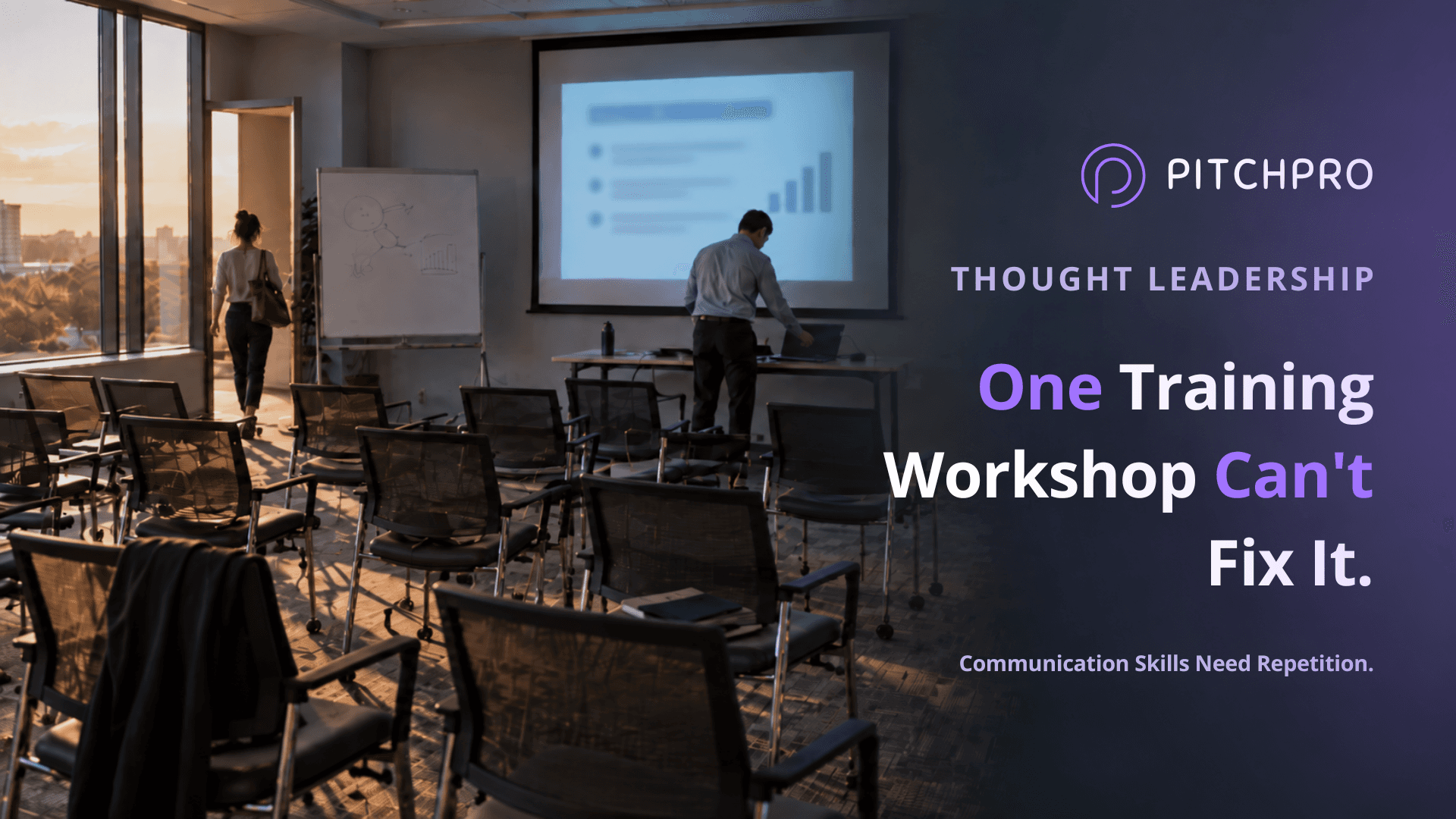
You sit through a communication workshop: slides, a role-play exercise, a certificate at the end. Everyone nods along. A few months later, the same team member still stumbles through the same tough conversation. The same manager still can't get a straight answer out of a report. Nobody can quite say why the training didn't stick.
It's not that the training was bad. It's that a single workshop was never going to fix a skill that only holds up through repetition.
Where the Money Actually Goes
The corporate training market is worth over $445 billion as of 2025, with companies spending north of $1,000 per employee a year on learning, according to an analysis of recent L&D (Learning & Development) spending data. Despite that scale, the same analysis found only about half of organizations can clearly say whether any of it actually improves performance.
The Gulf's own corporate training market, valued at $1.4 billion in 2025, is on the same trajectory, projected to nearly double by 2032, according to P&S Intelligence.
You'd think that scale of spending would mean the problem's basically solved by now. It's the opposite. A U.S.-focused report found 95% of HR managers agree stronger training improves retention. Employees agree right back. 73% say better learning opportunities would make them stay longer. 35% say the lack of them would push them to leave.
Across the wider MENA region, including Qatar, Bayt.com and a YouGov survey found 96% of professionals rate communication an essential skill today. It's expected to stay a top priority a decade out. The appetite for development has never been higher. The system delivering it hasn't caught up.
Why the Workshop Model Was Never Built to Last
The traditional model treats communication skill-building as an event instead of a habit.
It happens once or twice a year, which is roughly the worst possible schedule for actually retaining a skill. Most new information fades within days of a single session unless it's revisited, and each review session resets that decline and slows the rate of forgetting, a pattern known as the spacing effect.
Nothing fills that gap in between sessions either. Day-to-day feedback is subjective and delayed, since a manager might only review one live call every few months. The same report from earlier finds roughly half of HR leaders and employees say heavy workloads leave little room for the kind of ongoing coaching a skill actually needs.
Employees usually know what good communication sounds like. Producing it live, under pressure, is a different skill; it's the one that never gets rehearsed in a once-a-year session.
This isn't a fault in the people running these programs; it's a structural limit. A calendar built around quarterly events and a facilitator's limited hours can't manufacture enough realistic, repeated run-throughs.
Picture two departments running the same onboarding curriculum: a week of workshops on handling difficult conversations. Six months later, one team has moved on entirely. The other has kept running the same scenarios weekly, in short sessions, with feedback after each one. Only one built the reflex.
The Shift Already Underway
What's changing isn't the goal. It's what's actually possible. AI is making it feasible to turn communication development from an occasional event into an ongoing loop: attempt, specific feedback, adjustment, attempt again, on a schedule that doesn't depend on a manager's calendar or a workshop slot opening up.
That doesn't replace human coaching. It changes what a coach's limited time goes toward. The repetitive part, running the same pitch or objection response enough times to build the reflex, no longer has to compete for the same hour as the harder, judgment-based conversation.
This is the same principle behind PitchPro's AI Practice Modes: a way to run a specific high-pressure moment as many times as it actually takes, with concrete feedback attached each time, instead of hoping one rehearsal a year is enough.
What This Means for HR and L&D Leaders
The measure of a good communication program shouldn't be attendance. It should be whether the skill shows up in the room that actually matters, not just the session everyone was graded on. That's harder to track than a completion rate. It's also the only number that reflects whether anything actually changed.
Practically: treat repetition as infrastructure, not an event, so that people can rehearse realistic scenarios on their own schedule. Let the repeatable part handle pacing and structure, so a manager's limited hours go toward the harder calls, whether an argument holds up, not whether someone said "um" too many times.
Measure the behavior, not the attendance. A completed workshop only tells you who showed up.
Before You Go
The performance gap inside most organizations was never really about whether people know what good communication sounds like. It's about whether they've said it enough times, under real pressure, before the moment that counts.